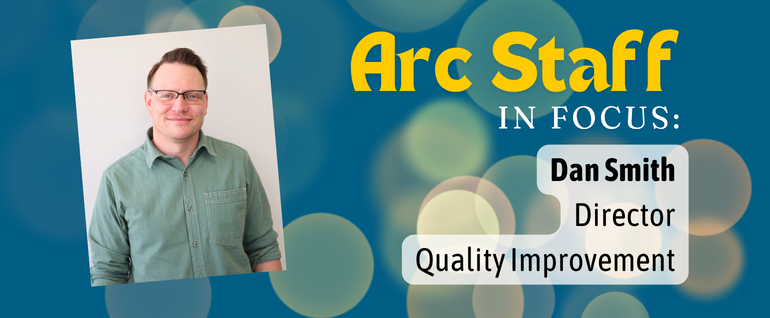
When Dan Smith was a student of music theory and composition, he had no idea he was learning lessons that would someday guide his work in human services. Today, as Director of Quality Improvement for The Arc of Essex County, he sees a clear throughline. “Composition was about the interaction of different elements,” Dan says. “That way of thinking, how small parts come together to create something meaningful, is exactly how I approach my work now.”
In his early 20s, Dan found himself searching for direction. He felt drawn to something purposeful, and when a friend introduced him to the field of intellectual and developmental disabilities, the impact was immediate. “I was really motivated to do something positive,” he says. “Once I got into it, it just felt like where I belonged.”
Dan began his career providing in-home respite and community-based mentoring. Working across the full spectrum, he quickly learned that beyond every diagnosis was a person with goals, preferences, and potential. “At the core of all of it, there’s a person who wants to live their life,” he says. “That grounded me early on.”
A pivotal influence during those early years was his first supervisor, a leader who helped instill person-centered values that still guide Dan today. “He really taught me to see opportunity, not disability,” he says. “To truly believe in people’s capabilities.” That mindset shaped not only how he supported individuals, but also how he understood himself. “I learned as much about myself as I did about the people I was supporting.”
After gaining experience in direct support and residential management, Dan transitioned into quality assurance, drawn by the opportunity to broaden his impact. “Instead of just affecting the people in my program, I could help improve services across an entire organization,” he says. That shift ultimately led him to The Arc, where he was inspired by something unique: longevity. “You see staff here for 20 or 30 years, and individuals supported for 40. That tells you something is working.”
Since joining in 2019, just months before the pandemic, Dan has helped reimagine what quality improvement can look like. When traditional auditing processes were disrupted, his team leaned into innovation. “We had the space to ask bigger questions: what does quality really mean, how do we measure it, and how do we improve it?” he says. The result has been a shift toward data-driven analysis, digitized tools, and a more proactive, organization-wide approach.
For Dan, quality improvement is not about sweeping changes, but about refining the details. “Our programs are already strong,” he notes. “It’s about the margins — small, thoughtful improvements that make a meaningful difference.”
Equally important is his ability to connect with staff. Having worked in direct care himself, Dan brings credibility and empathy to his position. “I know that when we make recommendations, they have to be practical. If it’s not easy to implement, it’s not going to work.”
Dan is happy to have a role where he feels supported by The Arc’s leadership and where analytical thinking, attention to detail, and search for meaning are central to his work. “In this field, the ‘why’ is clear: we’re here to improve people’s quality of life. If we’re not doing that, we’re doing it wrong.”